
AI Generate Content: A Brief-to-Draft Workflow with Human Quality Checks
The workflow uses a single AI-assisted content assignment to test whether drafting saves time without weakening quality. It starts with a clear brief and approved source packet, then requires factual ...


You have a tool, an approved brief, source material, and a named reviewer, and you are ready to ai generate content for the first time. The blank page is no longer the problem. The draft is. It may need heavy rewriting, or it may carry claims nobody can trace to a source, which leaves you unable to tell whether the tool saved time or only moved the work from writing to editing.
This article gives you a practical way to generate content with AI as one controlled pilot. You take a single assignment from brief to approval and record every correction along the way. It is written for B2B SaaS and professional-services content managers and agency production leads who start after tool selection, so it has no generator comparison.
The workflow runs in the order you will use it. First, you build a brief that defines audience, purpose, format, voice, evidence, and acceptance criteria. Next, you do source-backed drafting: you give the tool approved sources and tell it not to invent missing information. Then you verify each citation and claim independently, even when you supplied the sources. After that, you edit for reader intent, clarity, and differentiation before approval. Finally, you compare total production time and cost with your baseline, including rejected attempts. A short workshop-preparation example runs through the steps, and each step has a named owner.
We do not promise savings or publish-ready output on the first pass. The saving may be large, small, or absent, and each result tells you something useful. The tool handles repetitive drafting, while your people keep creative judgment, factual accuracy, and final approval. We start with the brief, because everything the tool produces depends on it.
Build a Brief the Tool Can Follow
Define the Audience, Purpose, and Format
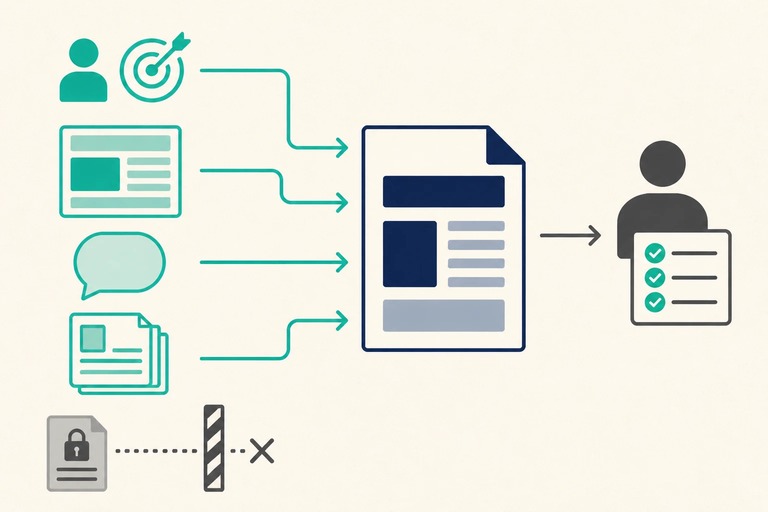
The brief decides whether the pilot succeeds or stalls. Name the reader first, for example an operations leader at a mid-sized firm. This leader knows process basics but has never run a mapping workshop. State the business purpose and the reader outcome, such as arriving with usable current-state information. A topic alone, like "write about process mapping," gives the tool nothing to aim at. Name the deliverable, channel, and length too. Use a 600-word article section for the firm's blog. Add a short subheading and a clear next step.
Set Voice and Evidence Boundaries
Describe voice in practical terms: direct, accessible, and professional, with short sentences and no hype. Paste one approved paragraph as a reference if you have it. List the evidence the tool may use, such as the firm's workshop checklist and methodology document. Exclude client names, confidential details, unapproved claims, and promises of specific results. Treat ai generate writing as a bounded drafting task. Clear context helps the tool stay on target. It cannot guarantee accuracy or brand fit, so your reviewer still checks both.
Make Acceptance Criteria Observable
Set criteria before generation so your reviewer judges against a standard instead of a feeling. Reuse the fields from your existing content brief and baseline. Each assignment follows that same process.
- Audience: operations leaders new to workshops
- Purpose: help them arrive prepared
- Format: blog section, set length
- Voice: direct, accessible, professional
- Approved evidence: checklist, methodology document
- Exclusions: client names, unapproved claims
- Acceptance criteria: required points covered, claims traceable, useful, on voice, approved by the named reviewer
Generate a Source-Backed Article Draft

Prepare a Small, Approved Source Packet
Give the tool a small packet of approved material, and keep the open web out of it. For each source, list the owner or publisher, title, and date. Add the location or URL and the claims the source may support. Prefer primary or authoritative sources for statistics, technical facts, and regulatory or professional claims. In our workshop example, the packet holds the firm's workshop checklist and its methodology document. State the rule plainly: use only these sources for factual claims. Write [SOURCE NEEDED] wherever evidence is missing. A visible gap is easier to fix than a confident guess.
Prompt for a Draft and Traceable Claims
Your prompt carries the whole brief, so put it in one block:
Draft a 600-word article section for [audience] to [purpose], in [format] and [voice]. Use only these sources: [source list]. Avoid: [exclusions]. Accept the draft only if: [acceptance criteria]. Do not invent statistics, quotations, citations, customer outcomes, or product capabilities. Keep qualifications attached to their claims. Return the draft, then a list of factual claims with the supporting source for each. Separate source facts from recommendations.
Models can still miss an instruction, so you check the output.
Keep the Example Short and Specific
Suppose the assignment is an operations article section on preparing for a process-mapping workshop. The tool returns this ai generate blog post excerpt:
"Bring your process steps, roles, and handoffs [supported by checklist]. Teams that prepare can cut workshop time by 30% [unsupported]. Label estimates clearly [recommendation; expert to confirm]."
The editor keeps the checklist-based guidance and removes the 30% promise, because no approved source states it. The estimate advice stays, labeled as a recommendation until the expert confirms it.
Verify Claims Before You Trust the Draft

Check Every Citation Against Its Original
Open each source and confirm that it exists. Confirm that it suits the claim and supports the wording at the stated strength. Check names, dates, numbers, and quotations, and keep the source's limitations attached to the claim. A supplied source can still be misquoted, misread, or attached to the wrong statement. A tidy citation proves nothing until you have read the passage it points to.
Record Claim Decisions
Give each material claim its own row. Use "verified" only when the source supports the precise wording, and a matching topic is not enough. Every unresolved claim then gets one action: remove, qualify, research, or route to a qualified reviewer.
| Claim | Source | Verification status | Reviewer | Required action |
|---|---|---|---|---|
| Process steps, roles, and handoffs | Approved checklist | Verify wording | Content reviewer | Keep or revise |
| 30% less workshop time | None identified | Unverified | Subject-matter expert | Remove or obtain evidence |
Match Review Depth to Risk
Name a reviewer who knows the subject and has the authority to request changes or reject the draft. Apply stricter scrutiny to legal, financial, health, safety, security, and performance claims, because wrong statements there cause harm. Record the decision and any unresolved issues. A vague "human checked" sign-off is not an accountable quality control. No one can tell what was checked or who owns the result.
Edit for Readers, Search Intent, and Approval

Revise for Intent and Clarity
Verified claims make a draft safe to edit, but they do not make it ready to publish. Ask whether it answers the question your reader came with. Compare it against the brief's audience, purpose, and format. Cut repetition, generic filler, and awkward phrasing. Soften sentences that sound more certain than the evidence allows. For example, "will reduce" becomes "can reduce, depending on the team." Add what the model cannot supply. Include a practical distinction from your own work, or an example your reader could repeat.
Review Voice and AI SEO Writing
A fluent draft is not automatically an on-brand one. Check vocabulary and tone against your style guide. Rewrite lines that sound like the model so they sound like your company. For ai seo writing, keep the checks simple. Do the headings serve the reader's task? Does the page cover the topic clearly? Using AI does not guarantee rankings or make content useful. Google's guidance targets scaled content made mainly to manipulate search results. Avoid keyword repetition, and never claim hands-on experience your team did not have.
Approve or Return the Draft
Decide using six criteria: brief fit, evidence, usefulness, voice, named review, and readiness. Remove, qualify, or assign for evidence gathering every unresolved claim before approval. If the draft fails, return it with specific revisions. Record the approver, the decision, and the required changes in one place. That record shows what passed, what came back, and why, and your later publishing gates can use it.
Measure the Pilot Against the Baseline

Compare Total Production Effort
An approved draft is only half the result. Track preparation, prompting, generation, verification, editing, approval, tool or research costs, and every rejected attempt. Compare like with like: the same content type, scope, quality bar, and review requirements. Setting first-draft time against finished-article time flatters the tool. Calculate cost per approved piece instead of cost per generated draft. Record revision rounds, fact-checking time, and the reasons any draft was rejected. Those reasons show whether the brief, sources, or prompt needs work.
Keep a Free-Tool Trial Bounded
If you test a free AI blog generator, keep the trial narrow. Use one assignment, with the same approved brief, source set, named reviewer, and acceptance criteria as your baseline. Changing any of them makes the comparison unreliable. "Free" describes access or subscription, and effort still has a price. Review time, staff hours, and rejected attempts cost your team. This pilot measures a workflow, so take tool-selection questions back to the earlier comparison of shortlisted tools.
Record the Outcome Before Scaling
Before you scale, write a short pilot record. Capture the content type and the baseline human minutes and cost. Add the pilot human minutes and cost, review rounds, unresolved claims, and the acceptance decision. When you test a free blog generator AI option, include verification and editing time in those minutes. You may find no saving, or even extra effort, and that is a valid result. Compare the approved piece and its corrections with the baseline. Keep the prompt, source set, review decisions, and outcome, because governance will build on them.
Make AI Content a Measurable Workflow
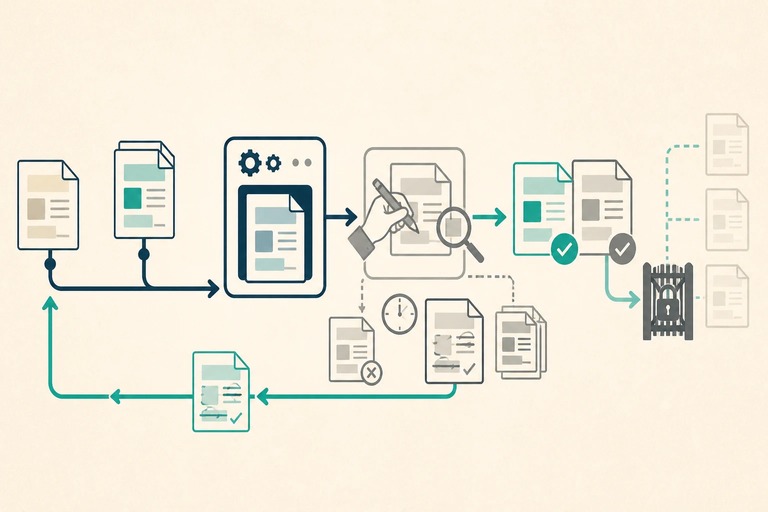
The result worth measuring is an approved piece, set against comparable work you have already produced. A fast first draft is only one number. The corrections your reviewer made, the review time, and the rejected attempts show whether the tool returned hours to your team or moved them from writing to editing. Either answer is useful, because it shows where the brief, the source packet, or the prompt needs work.
Your people keep the factual and strategic judgment. The tool handles repetitive drafting, and you decide what passes. That is how the blank page stops being a bottleneck without anyone giving up control of quality.
Your next step is to run the brief-to-draft trial on one assignment. Apply your brief criteria, claim review, and pilot record, and keep your baseline figures beside them. Then review the claims, editing time, and approved result in an implementation session before you increase volume.
Bring the corrections your reviewer made and your baseline figures to that session. They become the starting point for approval gates that govern generation and let you reuse approved content with confidence.