
AI SEO Content Generator: Build an Intent-Led Workflow with Approval Controls
An intent-led AI SEO workflow automates repeatable drafting tasks while keeping editorial judgment and publishing authority with people. Before drafting, teams approve the search-intent brief and evid...


Your pilot probably showed that an ai seo content generator can end the blank page for your team. Drafts arrive quickly, and publishing capacity looks larger than it did a quarter ago. Draft count, however, does not show whether a page is accurate, useful, or ready to go live.
When no one owns each decision, review work goes out of sight. Editors repair claims late, subject-matter experts get pulled in through chat messages, and the time saved on drafting returns as rework and risk. A sharper prompt will not fix that. Publish-ready content comes from a workflow with decision gates, named owners, and clear actions when a draft fails.
This guide extends a measured pilot into a governed production system for search engine optimization (SEO) content. We assume you already have a completed or representative pilot, search-intent criteria, a source-verification process, and defined publishing permissions. The errors, stalled reviews, and last-minute claim rescues in your pilot log are the raw material. Each one becomes a gate, an owner, and a defined response.
We begin by separating the tasks automation can handle from the editorial decisions people must own, and by applying the same controls to every way your team reaches a generator. Next, we validate search intent and source adequacy before drafting starts, so weak briefs never reach the draft stage. From there, we define acceptance tests for relevance, factual support, differentiation, and brand fit, and we name who approves publication. You will also see how to treat originality checks as editorial investigation rather than a detector score, and how to track first-pass acceptance, rework, review time, and cost per approved asset. Finally, we cover exception routing and the readiness criteria that tell you when to increase volume.
Your people stay in control of every edit, refine, or regenerate decision, while automation takes the repeatable work. By the end, you can configure approval gates for one content type and test an acceptable draft alongside a deliberately failing one, confirming that the failing draft is stopped before publication. The first step is deciding what the software may do and what it may not, which sets the boundaries for everything that follows.
Set Boundaries for the Automatic Content Generator
Automate repeatable work, not editorial judgment
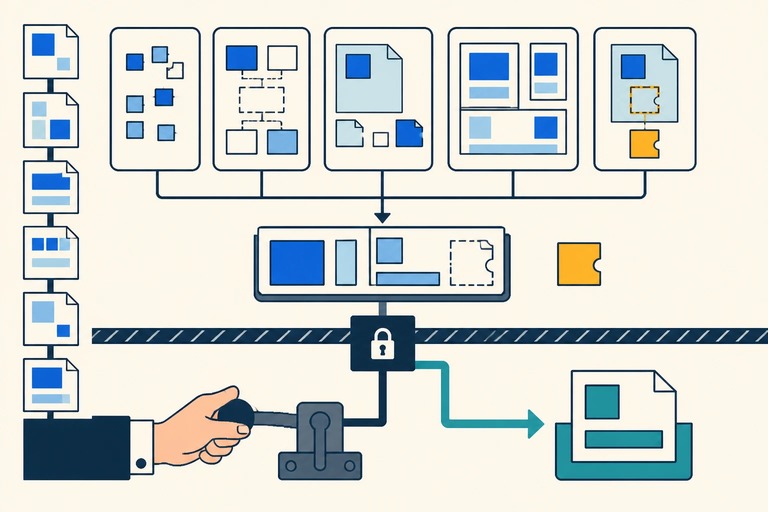
An automatic content generator is most useful when it takes over the repeatable steps that slow a team down. Five suit automation: clustering queries, suggesting outline options, organizing approved sources, formatting drafts, and flagging claims for review. Each is a support task with an output you can check. Handing them to software shrinks the blank page and gives your editors time back for strategy and creative work.
Judgment is different. People stay accountable for whether the intent is right, whether the evidence is sufficient, whether the page adds something distinct, whether it fits your brand voice, and whether it goes live. Software can prepare those decisions, but people make them.
Build one rule into the system: when a source is missing, the draft says so. The generator should flag unsupported information or leave a visible gap. It must never invent a statistic, a specification, or a quote to finish a paragraph. A gap costs an editor a minute. A fabricated fact that reaches publication costs far more.
Apply the same controls to every access route
Your quality and approval obligations stay the same whichever way your team reaches a generator. A free content generator and a paid platform both produce drafts, and both drafts need the same intent check, evidence check, and review. This section covers governed use only. If you are choosing between tools or plans, the separate tool-evaluation content is the better place to start.
Draw a hard line between creating a draft and releasing it. Generation access does not grant publishing authority. Anyone who can produce a draft should have no route to the live site without the named approver's sign-off.
Whatever the access route, keep one record for each asset:
- The approved brief
- The intent decision
- The approved sources
- The draft version
- The review decisions
- The published version
With that record, you can answer who approved a page, on what evidence, and what changed along the way. Without it, a correction becomes guesswork.
Validate Intent and Evidence Before Drafting

Turn search intent into an approved brief
The first gate is the brief, and it follows from the limits you set on automation. Before an ai seo content generator drafts a word, record the query cluster, primary user task, audience, expected format, must-answer questions, scope boundaries, and your confidence in the intent call. Base that call on current search results and your own Search Console query data. Treat keyword-tool intent labels and volume estimates as inputs, because they are not ground truth.
Name the page's distinctive contribution, such as a worked example or an operating method, so the draft gives the reader more than common coverage. Reject or re-scope any brief with mixed intent, unclear audience needs, or no defensible reason to be a separate page.
Approve a source set that can support the claims
Approve the evidence the draft may use. Prefer primary sources where practical, and record each source's URL, date, relevant passage, scope, and owner. Link every material claim to a passage that supports its exact wording, because a general reference list does not show that a sentence is true.
Check freshness and context for anything time-sensitive, including product specifications, policies, prices, laws, and statistics. A figure from one population or year can mislead when applied to another. If sources are missing or contradict each other, pause or narrow the brief. Never ask the model to fill an evidence gap, since a fluent guess is still a guess.
Make uncertainty actionable
Some uncertainty will remain, so label it. Mark intent as clear, mixed, or uncertain, and state what extra evidence could change the decision, such as a fresh results check or query data from Search Console. Send high-impact or regulated claims to a qualified subject-matter or compliance reviewer before drafting when possible.
Keep the approved brief and source set with the content record, so later reviewers can see whether the draft stayed in scope. Treat evidence approval as a real gate. If no approved evidence supports a proposed claim, generation does not start on that scope, and the brief returns to its owner.
Make Acceptance Tests and Publication Approval Explicit
Test the content AI writer’s draft against reader needs
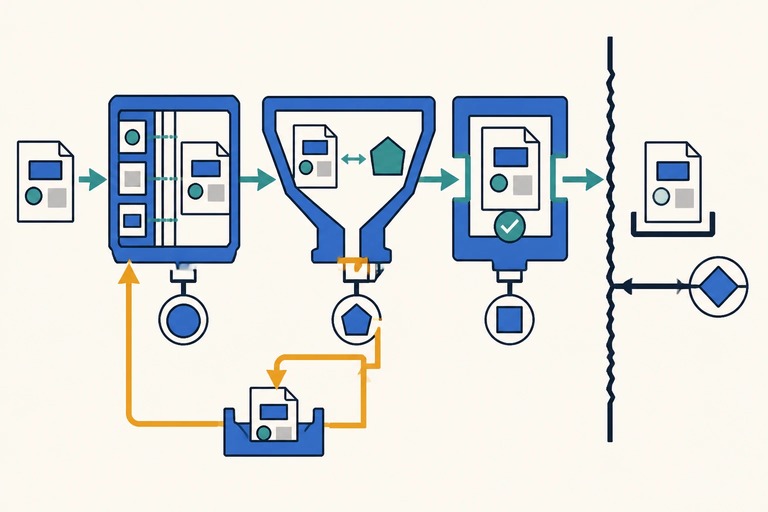
A draft needs a fair test once the brief and sources are approved. Define pass and fail criteria before the run starts, and set two hard stops: no unresolved intent mismatch and no unsupported material claims. Then check relevance, factual support, completeness, and qualifications such as dates and limits. Ask whether the intended reader can make progress on their task.
When you review an article AI generator draft, test it against the intended page format and task. Keyword presence and fluent prose are not the test. Google's guidance sets a value-and-purpose standard. AI use alone does not break it, but scaled production meant to manipulate rankings can violate its spam policies.
Require a useful contribution and brand fit
Accurate content can still be generic. Ask the reviewer to name the specific contribution: original expertise, a useful method, proprietary data, a worked example, or meaningful synthesis. If a blog post AI generator draft only rearranges what the top results already say, it does not deserve a page.
Check brand voice, product claims, audience expectations, accessibility, and any disclosure rules that apply. Brand tone analysis can help a draft sound like your site, but you decide whether it says something worth publishing. Return generic drafts for substantive revision. Polished tone and keyword coverage cannot replace distinct reader value.
Assign approval ownership and publishing authority
Every gate needs a named owner. Each decision should record the evidence, the reason, the date, and the content version. Keep generation, editing, specialist review, and final publication permissions separate. A review timeout must never silently authorize release. If no one responds, the asset stays held.
| Gate | Accountable owner | Decision record | If it fails |
|---|---|---|---|
| Brief and evidence | SEO lead and subject-matter reviewer | Intent record, source-to-claim map | Return or narrow scope |
| Claim review | Subject-matter or compliance reviewer | Claim-by-claim decision | Remove, qualify, or block |
| Acceptance tests | Editor | Test results, contribution note | Revise or reject |
| Publication | Named publishing owner | Approved version, date, reason | Hold release |
Investigate Originality and Measure Approved Output

Treat originality checks as editorial investigation
A similarity report points to passages. It does not give a verdict. Use similarity tools only to find passages worth a closer look, and treat AI-detector scores the same way. Neither proves a draft is original or shows who wrote it. Liang and colleagues reported in Patterns in 2023 that several detectors misclassified writing by non-native English speakers more often than native writing, so a score alone is an unfair reason to reject work.
When a passage is flagged, an editor compares wording, structure, and examples against the matching source. Check whether the source is credited and whether each citation supports the claim attached to it. Then ask what the draft adds to existing coverage. Revise or attribute the material, or return the draft for new expertise.
Make a blocked claim a practical test
Consider a hypothetical case. An ecommerce draft from an AI generator blog workflow calls a backpack "certified climate-neutral." The approved product record confirms only recycled fabric. Recycled material is not a certification, so the reviewer blocks the claim.
The reviewer has three options. Remove the claim. Narrow it to wording the record supports, such as the recycled fabric. Or obtain authoritative evidence that covers the exact product, scope, issuer, validity period, and permitted wording. Whichever you choose, record the decision, the evidence, and the reason in the version history. A later editor can then see why the draft changed or stopped.
Measure the cost and quality of the workflow
Measure approved output. Generated output shows only how many drafts the system created. Track first-pass acceptance, substantive rework rate, active review time, elapsed time to approval, evidence failures, intent failures, exceptions, and post-publication corrections. Calculate cost per approved asset by adding research, editing, review, generation, and tooling costs, then dividing by assets approved. Compare results by content type and risk tier, and pair them with quality audits so a high acceptance rate cannot hide weak review.
For a hypothetical ROI illustration, subtract added review cost from potential rework avoided. Estimate avoided rework as the chance of a correction multiplied by its cost. These figures are assumptions, and they are not observed savings. Replace them with your own pilot data.
Scale Only When Review Capacity Can Keep Up

Route exceptions to the right reviewer
Once you can measure cost and quality, decide what happens when a draft fails. Route each exception by type. Send unclear intent to an SEO strategist or senior editor. Send regulated or high-impact claims to a qualified specialist or compliance reviewer. Return missing or conflicting evidence to the research owner or editor, and pause generation or publication until it is resolved. Send brand, product, or policy claims to the matching product, brand, or legal owner.
Define four decisions. Block stops the draft. Revise returns it with specific changes. Escalate moves it to a higher authority. Waive, if you permit it at all, needs a named approver and a written reason. Record the reason for every exception so someone can audit it later.
Test that failure handling works before increasing volume
Before you raise volume, run a supervised review on representative content. Include one deliberately failing draft, such as the backpack draft with the unsupported certification claim. Confirm that the draft is blocked, that it reaches the right owner, that it is corrected with suitable evidence or narrower wording, and that it does not publish by default.
Then set queue limits and stop rules. If the review queue passes its limit, generation pauses. Draft output should stay within the capacity of trained reviewers. Name one owner who can correct, unpublish, or roll back content, and keep the version and approval record. People stay in control of every edit, refine, or regenerate decision, and these limits protect that control.
Use readiness criteria to make the scale decision
Expand when every gate has an accountable owner, exceptions have working routes, and reviewers can trace claims to current approved sources. Confirm that version history, publishing permissions, correction authority, and capacity for high-risk review are in place. Look for evidence that quality holds across representative content types and across more than one reviewer, at an acceptable cost per approved asset.
If your team cannot reliably stop, resolve, and learn from a failing draft, it is not ready to increase volume.
Put Your AI SEO Content Generator Under Control

Start with one content type, the one that produced the most late claim rescues in your pilot. Assign a named owner to each gate: brief and evidence, claim review, acceptance tests, and publication. Write down what each owner needs to see to pass a draft and what happens when it fails.
Then run a supervised session with two drafts. The first should meet your acceptance tests. The second should fail on purpose, such as a product draft with an unsupported certification claim. Watch where each draft goes. The acceptable draft should reach the publishing owner with its brief, sources, and review decisions attached. The failing draft should be blocked, reach the right reviewer, and stay out of your CMS until someone corrects it with evidence or narrower wording. If it moves forward by default, you have found a gap in the gate, and that is what the session is for.
If your team needs help naming owners or settling exception paths, book a governance implementation session with us. We will work through the gates with you, and your people keep every edit, refine, or regenerate decision. You can also run the same supervised approval-control trial on your own.
Once approval works for that content type, take the approved asset into a review of your writing stack, then into repurposing approved content. Each step reuses the controls you have already proven, so publishing capacity grows while your team stays in charge of what reaches the reader.