
Outline Blog Content Before Drafting: A Repeatable Planning Method
A repeatable blog-planning method turns a brief into an editorial contract that aligns the audience, business goal, intended reader outcome, and exclusions before drafting. It orders reader questions ...


A broad brief leaves the blank page just as empty as before. A topic and a business goal do not tell a writer which reader questions to answer or which subjects to leave out. When you outline blog content from one real brief before generating prose, you give strategists, writers, subject-matter experts, and approvers the same plan to react to.
Gaps in that plan return later as rework. Missing or poorly ordered questions force rewrites, unapproved scope sends reviewers back to sections nobody agreed to, and a writing assistant can add fluent tangents that miss the brief's purpose.
This article assumes you already have a defined audience, a business problem, and the fields from Blog Outline: A Reusable Template for Clear, Purposeful AI-Assisted Content. We apply them to a hypothetical SaaS onboarding brief in four steps. You will extract the audience, business problem, intended answer, and exclusions. You will order reader questions from prerequisite knowledge to action. You will assign evidence requirements and flag support you cannot yet provide. Then you will run a heading-adherence test with one shortlisted tool and record planning minutes, revision rounds, and rejected headings as a workflow baseline.
We start by turning the brief into an editorial contract, the written agreement that approvers confirm before drafting begins. Your team keeps control of every decision, and the plan makes each one visible.
Turn the brief into an editorial contract

Extract the audience, business problem, intended answer, and exclusions
Start with four plain statements. The audience is defined by situation and need. One example is an operations manager at a SaaS company who loses days to setup handoffs. This person wants to know where the process breaks. The business problem is separate: the company wants content that shows it understands onboarding friction. The intended answer is what the reader can do afterward. One example is listing the handoffs in their own setup process. Exclusions name what stays out: enterprise operating models, unmeasured time-saving claims, and product promises.
Check that the article serves both reader and business
A brief works only when it serves both sides. The reader searches for a way to fix a problem. The business wants to be useful to someone who has that problem. Keep those purposes connected, and keep each section from turning into a pitch. Offer a next step, such as a planning conversation, only after the article has answered the reader's question. When you do not know the reader's team size or data access, mark it unresolved. A visible gap is easier to fix than a hidden assumption.
Make the agreement visible before approval
Put the full chain in the working plan so approvers can see it. It runs from business problem to reader question, intended answer, heading, evidence need, and exclusion. Each row is one commitment. Before drafting starts, ask approvers to confirm the questions, the answers, the evidence needed, and the boundaries. A change at this stage costs a sentence. The same change after a draft exists costs a rewrite. For the reusable fields themselves, return to Blog Outline: A Reusable Template for Clear, Purposeful AI-Assisted Content. This article applies those fields to a real brief.
Order reader questions from prerequisite knowledge to action
Build a sequence that follows the reader's decisions
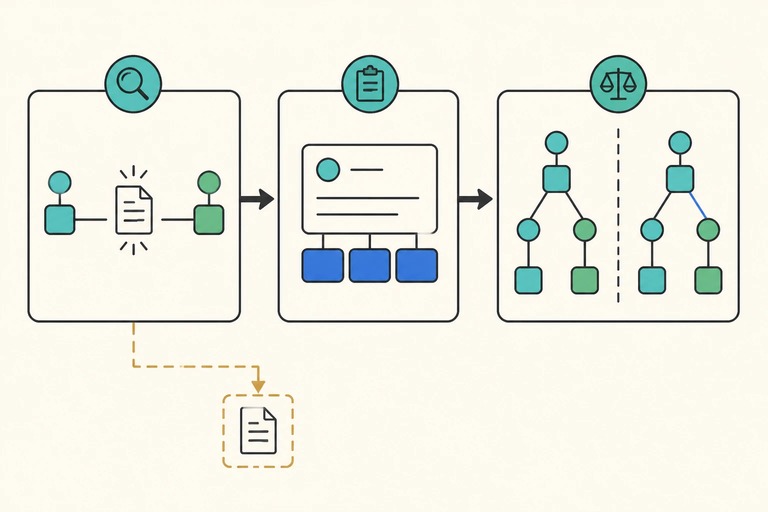
List every question the reader must resolve. Then order them from essential context to next action. For each proposed heading, ask what the reader needs to know first. Then ask what decision or task the section enables. When you outline blog content this way, the sequence follows the reader's choices. Remove questions that are interesting but do not advance the intended answer. Note why each one left: out of scope, duplicate, or unnecessary before action.
Use a hypothetical SaaS onboarding brief to test the sequence
Here is the continuing example, and it is hypothetical. A SaaS operations manager wants to understand and reduce setup handoffs. The questions run in this order: Where do handoffs create friction? What information should move with a task? How can a process change be assessed? The first gives context, the second gives a standard, and the third gives a way to judge change. This sequence only identifies useful questions. Any customer outcome or software effect on handoffs needs its own proof.
Confirm each heading has a distinct job
Each heading needs its own job. If two sections give the same answer in different words, merge them or cut one. Check that context comes before recommendations, and that measurement comes after the process it measures. In the onboarding example, friction must be understood before handoff information is defined. Both must come before any before-and-after comparison. We carry this same brief into the annotated examples and controlled drafting modules. You can then watch the method work across stages with the same inputs.
Assign evidence requirements before drafting
Specify support for important claims and examples
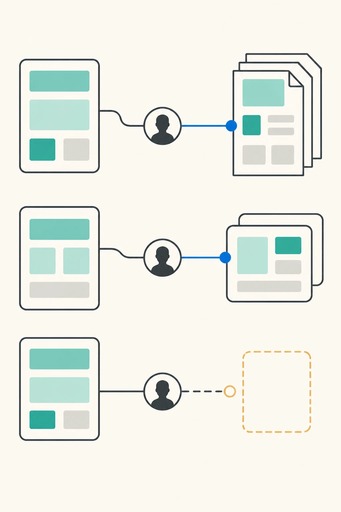
Decide what each section needs to prove. For every section, name the claim or example it may include. Then name the evidence that would support it. Likely source types include published research and internal product or process data. Others are a customer interview, a documented case, or author explanation. Give each item an owner and a status: available, needs verification, unavailable, or not applicable. Writers, SMEs, and approvers can then read the same evidence record before anyone drafts a sentence.
Flag unavailable support rather than filling the gap
When support is missing, mark the claim "[evidence needed]" and make one decision. You can find support, narrow or qualify the claim, label it as hypothetical, or omit it. Fluent AI-generated wording is not evidence. Citations or statistics a tool supplies without a source you have checked are not evidence either. Keep two judgments apart. Factual accuracy asks whether a claim is true and supported. Outline adherence asks whether the draft followed the plan. A draft can pass one and fail the other.
Apply the evidence map to the onboarding example
In the hypothetical onboarding brief, the evidence map is short. These are planning requirements:
- "Handoffs create friction" → product workflow data or customer interviews.
- "Minimum handoff information" → process documentation or SME review.
- "Measure a change" → comparable before-and-after handoff counts.
Claim days saved, or credit software for an improvement, only with measured and relevant evidence. Carry these same requirements into the section-level instructions you give a writing assistant. That way you set support before drafting.
Test outline adherence and establish a workflow baseline

Run a bounded test with a shortlisted writing assistant
Test whether a tool respects the evidence needs you assigned. Pick one shortlisted tool and one narrow assignment. Skip the hunt for the best AI blog writer. Give the tool the same approved brief and outline each time. State whether it may rename, add, remove, or reorder headings. Start with the outline or one defined section so deviations are easy to spot. A free blog AI writer or limited-access plan can take the same small assignment.
Check heading order, scope, and evidence handling
- Questions: Pass if every required question appears once. Fail if one is missing or duplicated.
- Order: Pass if the approved order and section purpose hold. Fail if headings move or sections repeat.
- Scope: Pass if exclusions hold. Fail if unrelated or excluded topics appear.
- Evidence: Pass if evidence is traceable or marked "[evidence needed]". Fail if facts, sources, or examples are invented.
Treat compliance as one task-specific result. It says how this AI blog writing tool handled this assignment. For AI blog writing free options, compare only what each offers on the same task.
Record results and measure the whole workflow
Log planning minutes, substantive revision rounds, rejected headings with reasons, and drafting and editing time where relevant. Define the counting rules first. For example, a revision round is a submitted version followed by a substantive change request. A copy edit does not count. Keep the brief, prompt, output, corrections, and reviewer criteria so anyone can repeat the test. Then compare total planning, drafting, and editing minutes before and after adoption. Rankings, conversions, and reader satisfaction need separate measurement before you claim the method improves them. For broader tool comparisons, return to the evaluation scorecard in our AI blog writer guide.
Make an outline blog plan you can approve

Before you draft, check that every heading serves the reader problem and intended answer in your brief. A heading that fails belongs on the rejected list with a reason, not in the draft. That keeps the blank page from filling with fluent tangents and keeps approvers reviewing a plan they already agreed to.
Your next step is small. Choose one real brief, such as the hypothetical onboarding example, and outline it using the exclusions, question order, and evidence statuses described above. Run one shortlisted writing assistant against the pass/fail criteria. Record scope drift, approval criteria, planning minutes, revision rounds, and rejected headings, and hold your conclusions until you have the numbers.
Then request a planning implementation session. We will review your scope drift and approval criteria with you, and you can follow the same brief into our upcoming annotated examples to see how the method shifts with each business goal.