
Tone of Voice Guidelines: Adapt Your Brand to Each Customer Situation
Effective brand communication keeps a stable voice while adapting tone to the customer’s situation, likely needs, and the message’s purpose—not merely the channel. A practical tone matrix translates f...


A seasonal sale email and a failed-payment error message can reach the same customer on the same day. Upbeat copy that helps the first reader decide can feel dismissive to the second, who is blocked. Stiff formality can make routine guidance feel cold. Testing whether the same enthusiasm helps both readers complete their task shows why one emotional register cannot serve every message. Writing tone of voice guidelines that hold up in practice means separating two ideas: voice is the stable set of brand attributes, and tone is how those attributes show up in a specific situation.
You likely already have defined voice attributes and access to real customer scenarios, whether you work in e-commerce lifecycle marketing, SaaS UX writing, or professional-services content. Channel rules such as "email is formal" or "social is casual" ignore what the customer needs and may be feeling. This article builds on the stable attributes from your brand voice guide and shows how to adapt tone without changing who you sound like.
We begin with the customer situation, likely audience emotion, and communication purpose, treating emotion as a working hypothesis that you validate against support cases and feedback. Next, we turn formality, empathy, enthusiasm, and humor into observable settings in a context-first matrix, then show how stable voice attributes and factual clarity persist across contrasting messages. We close with documented exceptions and reviewer judgment for sensitive cases such as payment failures. To put it to use, compare the promotion and product error rows in the matrix, then request a review of the scenario your team handles least consistently, so the feedback targets the inconsistency you actually have.
Start With the Customer Situation, Not the Channel
Identify what the customer needs now
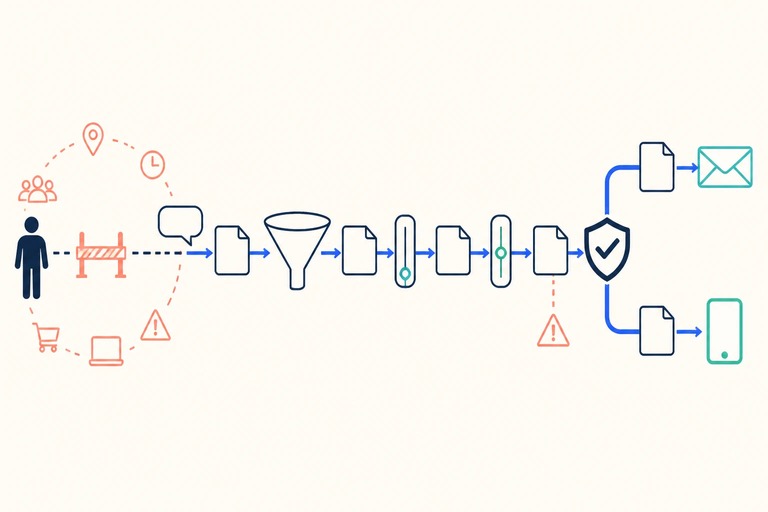
Start with three questions. What happened? What is the customer trying to do? What do they need to understand or do next? A shipping delay, a failed payment, and a first login all create different answers. They may still arrive in the same inbox.
Then weigh four factors: customer state, urgency, consequence, and relationship. A first-time buyer and a long-term account holder may need different reassurance. Treat feelings such as frustration or uncertainty as likely states to investigate, not facts about every customer. Check them against support tickets, reviews, and survey comments. Some customers who hit an error are simply curious.
Use channel constraints after context
Channel shapes format, length, and interaction. It does not set the emotional register. Take a fraud alert. In email, you have room to explain what was detected. You can also say what the customer should do and how to reach support. In an app notification, you have a few words and a tap. The formats differ, but both messages need clear facts and a serious tone.
Channel stereotypes cause the most damage when they override context. "Social is playful" breaks down when a customer reports a problem publicly. A joke in that reply reads as dismissal, and everyone watching sees it.
Connect tone to purpose and risk
Tone should serve the purpose of the message. Onboarding builds confidence. A promotion explains an offer so the reader can decide. A support reply restores trust. An error message helps someone recover.
Risk sets how much review a message needs. Raise the threshold when a misunderstanding could affect safety, privacy, money, access, or customer trust. A billing failure deserves more scrutiny than a welcome email.
Use this sequence: situation → likely emotion → purpose → tone settings → channel constraints → review or exception. Treat the likely emotion as a hypothesis, and revise it when support cases disagree. Each step narrows the next, so writers decide on evidence before they pick adjectives.
Turn Brand Tonality Guidelines Into Observable Settings

Define settings writers can apply
Labels such as "friendly" or "empathetic" are too broad to guide a writer. Each one needs to point to choices you can see in wording, sentence structure, or punctuation. Define formality through word choice and conversational phrasing. Contractions and direct address read as casual. Full sentences and titles read as formal. Define empathy as specific acknowledgment of known impact, such as "your order is two days late." It is not a claim about how the customer feels. Define enthusiasm as the amount of positive language, including exclamation marks and celebratory words. Treat humor as optional, and use it only where it will not minimize a problem.
Build a context-first tone of voice matrix
This matrix is an illustrative starting point. Adapt it, then validate it against your customers and policies. Each row pairs settings with purpose. Writers see why a tone fits, not just which label to copy.
| Situation | Likely audience emotion | Purpose | Formality | Empathy | Enthusiasm | Humor | Review notes |
|---|---|---|---|---|---|---|---|
| Onboarding | Curious, uncertain | Build confidence, prompt the next step | Conversational | Reassuring | Moderate | Light, if it does not distract | Check that encouragement does not overpromise |
| Promotion | Interested, skeptical | Explain the offer so the reader can choose | Conversational | Respectful | Moderate to high | Optional | Verify claims, terms, and urgency |
| Support problem | Frustrated, worried | Acknowledge impact, restore trust | Clear, respectful | High, specific | Low | Avoid | Confirm owner, next step, timing |
| Product error | Confused, blocked | Explain what happened and how to recover | Plain, direct | Calm | Low | Avoid | State problem and fix; do not blame the user |
Make the settings usable across teams
Short examples keep "low," "moderate," and "high" from drifting between writers and reviewers. "Your refund is on its way" shows low enthusiasm. "Your first order is on its way, and we're glad you're here!" shows high enthusiasm. "We've logged the issue" shows low empathy. "The delay meant your order missed Friday's event, and we're sorry" shows high empathy. Adjust these to your own voice before sharing them.
Keep the matrix adaptable. A billing failure or security warning may need stricter review than a routine validation error. Use the matrix to guide judgment. Do not use it to generate answers automatically. Never treat it as a replacement for customer research.
Keep One Voice Across Contrasting Situations
Show how stable attributes travel across situations
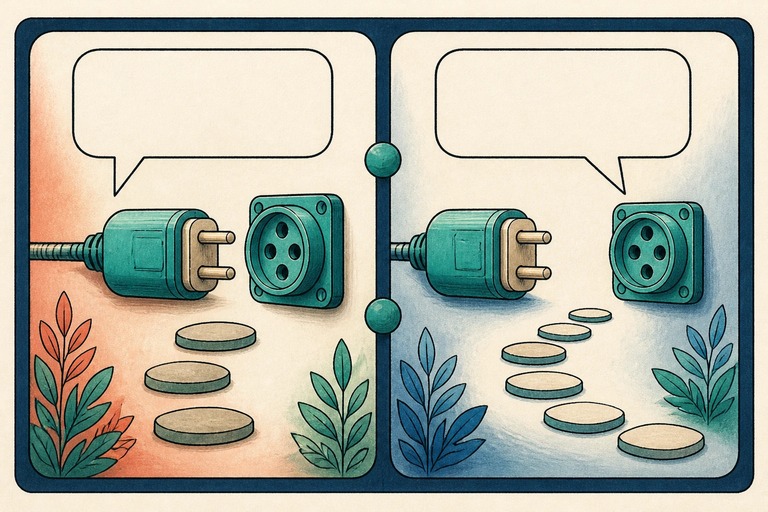
Settings change how a message sounds. Voice attributes decide whether it still sounds like you. Take the attributes from your brand voice guide, for example plain, confident, and helpful. Each one should appear in a product launch email and in an outage notice. The formality, enthusiasm, and humor settings differ between them.
This is what keeps contextual adaptation from becoming uncontrolled variation. Writers adjust the settings in the matrix, but they do not swap the attributes. Apply a recognition test. Could a customer identify the same brand in a celebratory message and in a serious service update? If not, the tone has drifted into a different voice.
Voice and tone guide examples: onboarding and an error
Consider a store-connection flow. The onboarding message reads:
You're ready to connect your first store. Follow these three steps to sync your products.
It is plain because it names the task. It is confident because it assumes the customer can finish it. It is helpful because it sets expectations for the steps ahead.
Now the error:
We couldn't sync your products. Check your store connection and try again. If the problem continues, contact support.
The same attributes hold. The sentences stay short, the verbs stay direct, and the customer still gets a clear next step. What disappears is the celebration. The error version states what happened and how to recover. It does not congratulate the customer or make light of the interruption.
Protect clarity and customer trust
Tone never outranks information. In every situation, a message should make clear what happened and what is known. It should also state what the customer should do and any deadline or consequence. Accuracy, clear instructions, respect, and accessibility come ahead of stylistic flourishes.
Three habits erode trust. Softening a warning until it becomes unclear leaves customers unprepared for the consequence. Using warmth to hide a delay makes friendliness feel like evasion. Claiming to know exactly how a customer feels sounds presumptuous. Name a specific, known impact instead, such as "This delayed your order."
Document Exceptions and Reviewer Judgment

A stable voice across situations works only if you also know when the guidance should step aside.
Decide when guidance needs a human exception
Treat security incidents, payment failures, account lockouts, reported harm, and uncertain or changing facts as higher-caution cases. For each one, record the exception trigger and the information the message must contain. Record the language it must avoid and the condition that escalates it. Also record who may approve a departure from the matrix. A named approver keeps flexibility from becoming guesswork. Reviewer judgment is part of the system. No matrix anticipates every customer, cultural context, or high-impact event.
Choose scripts, contextual guidance, or a hybrid
Match the level of control to the risk. Use fixed wording for legal disclosures and safety-critical instructions. Use flexible language where the customer's context calls for it.
| Approach | Consistency benefit | Exception risk |
|---|---|---|
| Rigid scripts | Predictable wording and required disclosures | Can feel impersonal |
| Contextual guidance | Adapts to the situation | Needs clear ownership |
| Hybrid | Fixes required facts and actions, allows suitable phrasing | Must mark what is fixed |
Ask reviewers to separate mandatory content from adaptable tone, so flexibility never changes policy or facts.
Test whether the guidance is understood
Pilot the matrix with 10 to 20 representative scenarios. Ask at least two reviewers to rate formality, empathy, enthusiasm, and humor independently on a defined scale. Track exact agreement, then categorize each correction as tone, accuracy, policy, or legal risk. Compare results with your own baseline, since we have no verified industry benchmark to offer. Where you can, pair editorial review with comprehension, task-success, support, or qualitative feedback. A small pilot is a diagnostic, not proof of business impact.
Make Tone of Voice Guidelines Work in Context

Your tone of voice guidelines earn their value in the moments where two messages pull in opposite directions. Open the matrix and place the promotion row beside the product error row. Notice how formality, empathy, enthusiasm, and humor move between them, while the plain, confident attributes of your brand voice stay put. That contrast is the test of whether your guidance works.
Next, ask which of those two situations your team handles least consistently. Pull two or three recent examples from that scenario, along with any related support tickets or customer comments, so the evidence shows where writers disagree. Then request a review of that scenario. A review aimed at one real inconsistency gives you feedback you can act on, and it shows whether the settings need clearer examples or a documented exception.
When you want to see these decisions explained in real copy, read Brand Voice Guidelines Examples: Annotated Rules and Before-and-After Copy next. It annotates contextual choices, so you can check your own revisions against worked cases before you roll them out.